Confirm the chemistry
Record formulation, concentration, SDS, temperature, viscosity, foam, solids, cleaning fluids and known restrictions.
Published model evidence
Compare current first-party model data, understand what each figure means and identify the product, pack and site evidence still needed before a chemical filling machine is approved.
How to use this comparison
The reference figures below were checked against current Lancing first-party product pages on 20 August 2026. They identify real model codes, filling principles, published ranges and example output conditions. They should be reconfirmed at quotation because head count, options and source data can change.
Final suitability depends on the exact formulation, concentration, temperature, viscosity, foam, solids, container tolerances, closure, utilities, cleaning method and site environment. A representative trial should use the approved product and packs whenever those variables can change the result.
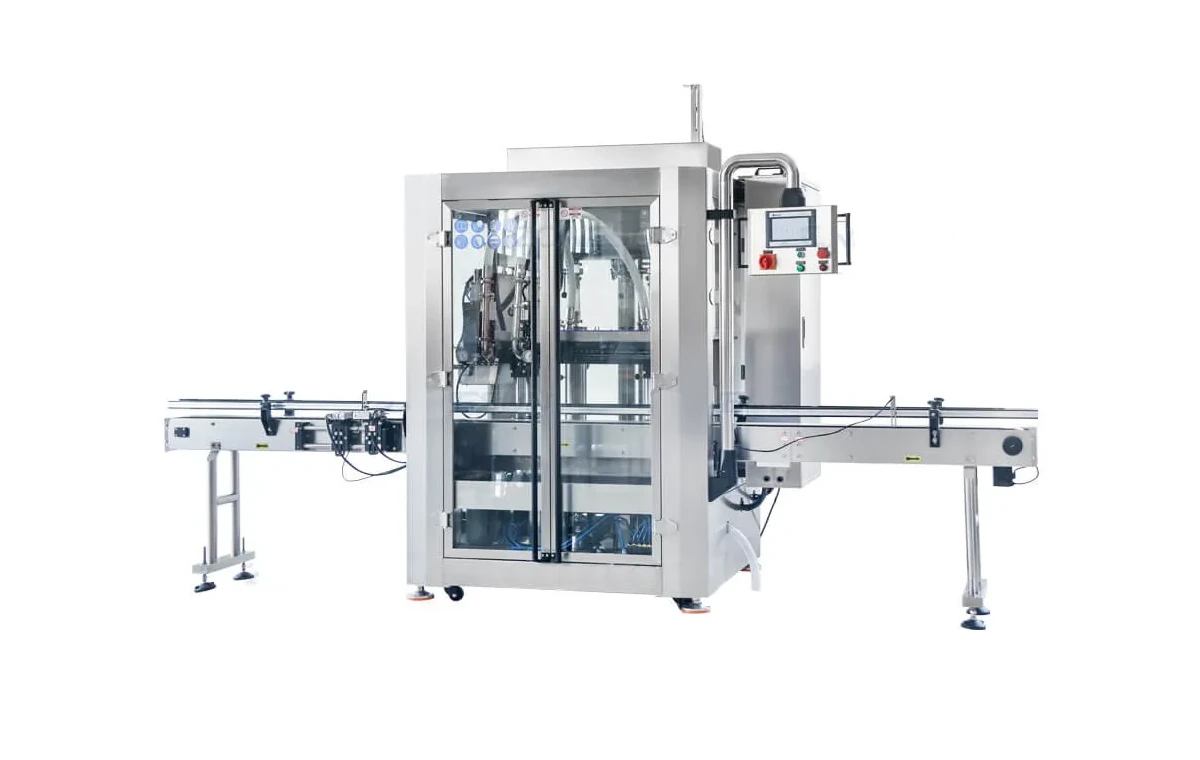
Issue one controlled duty and ask each route to state included equipment, assumptions, excluded interfaces and the conditions behind every speed or accuracy statement.
Verified model shortlist
The values are published reference data, not guaranteed output for an untested product.
| Model | Published filling route | Published reference data | Best next proof |
|---|---|---|---|
| LUYTCR4A | Automatic gravity filler with anti-corrosion nozzles and non-metal product-contact route | Four heads; 100–3000 ml; bottle diameter 60–120 mm and height 60–300 mm; approximately 200–2500 bottles/hour depending on dose | Approve every wetted component for the actual chemistry and test smallest/largest packs, low supply level, cut-off and drainage. Open the Lancing source page. |
| LUYTCR2 | Semi-automatic, fully pneumatic corrosion-proof filler with all-plastic contact path | Two heads; 200–1000 ml; approximately 10–30 bottles/minute depending on dose and operation | Prove operator presentation, bottle support, pneumatic duty, chemical compatibility and return-to-service checks. Open the Lancing source page. |
| LUVTDP40 | Automatic four-head diaphragm-pump filler | Four independently controlled nozzles; published maximum flow 40 L/min; approximately 30–45 bottles/minute | Test the production detergent or gel, source aeration, foam, nozzle motion, settled fill and line balance. Open the Lancing source page. |
| LUSVPP80C | Servo-controlled four-channel peristaltic filler | Recommended approximately 10–500 ml; maximum flow approximately 2.4 L/min per channel; 10–20 bottles/minute at 100 ml water reference condition | Approve tubing material and geometry, then calibrate every channel with the final tube, nozzle and product supply. Open the Lancing source page. |
| LUDTHSP2 | Compact automatic piston volumetric filler | Two heads, configurable to four; published cylinder modules from 5–100 ml to 1000–5000 ml; approximately 10–30 bottles/minute | Confirm viscosity/rheology, cylinder selection, nozzle shut-off, pack indexing, cleaning and actual production output. Open the Lancing source page. |
Selection sequence
Record formulation, concentration, SDS, temperature, viscosity, foam, solids, cleaning fluids and known restrictions.
Use production containers, necks, closures, labels and tolerated dimensions rather than ideal samples only.
State dose range, batch sizes, good output, supply level, restart, changeover and line interfaces.
Define trial, quantity, leak, closure, FAT, SAT, training, documentation and post-maintenance checks.
Important limitation
Material families such as PTFE, polypropylene, PVC, HDPE, stainless steel, EPDM and FKM can behave differently by grade, concentration, temperature, pressure, mechanical duty and cleaning exposure. Final approval should identify every wetted component and the evidence supporting the exact duty.
Speak to Lancing
Send the product identity, SDS where relevant, fill range, containers, closures, output target, cleaning method, site constraints and representative samples.