Container supply
Record empty-container shortages, unstable packs, guide adjustments and accumulation at the filler entry.
Line-performance evidence
Measure accepted finished packs over a defined operating period and retain the loss-state evidence needed to explain availability, rate and quality.
Direct answer
A chemical filling line should not be accepted from the filler’s isolated cycle rate alone. Define the line start and finish points, planned production time, product and pack, reference rate, acceptable finished pack, reject rules and normal operating interruptions. Count saleable packs at the agreed discharge after filling, closure, label, code and inspection.
Overall equipment effectiveness (OEE) can organise availability, performance and quality losses, but the calculation is only useful when every party uses the same time base, rate and quality definition. The machine specification should state the raw events needed to reproduce the result rather than relying on one unexplained percentage.
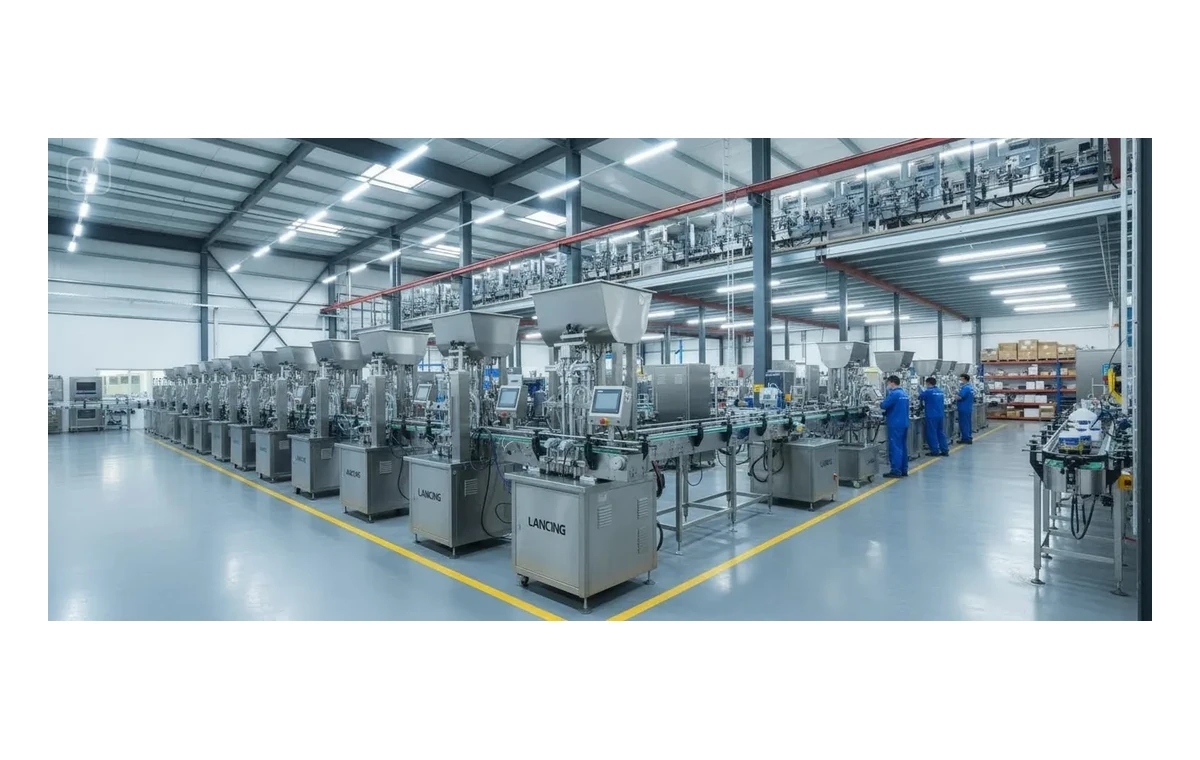
Include fill quantity, closure, leak, label, code, inspection and reject confirmation so rework and failed packs are not counted as useful output.
Common definitions
| Term | Definition to agree | Typical evidence |
|---|---|---|
| Planned production time | The period in which the line is expected to make the specified product and pack, with planned exclusions stated | Shift or test start/finish, planned breaks, cleaning and changeover treatment |
| Availability | Time the line was capable of running compared with the agreed planned time | Stop start/end, fault code, cause, responsible station and recovery confirmation |
| Performance | Actual production rate compared with the agreed demonstrated reference rate for that SKU | Pack counts, run time, starved/blocked state, reduced-speed mode and station rates |
| Quality | Accepted packs compared with total packs processed under the agreed inspection rules | Fill, cap, leak, label, code and reject results; rework treatment |
| Good output | Accepted finished packs produced at the specified line boundary during the observation period | Counter reconciliation, reject confirmation and retained acceptance record |
Line balance
Record empty-container shortages, unstable packs, guide adjustments and accumulation at the filler entry.
Separate low product, lost prime, quantity correction, nozzle cleaning and product-condition reductions.
Record cap replenishment, misfeeds, no-cap states, torque faults and filled-but-uncapped recovery.
Identify web or ribbon changes, label absence, code verification and product-specific setup loss.
Reconcile the detected fault, reject action, reject confirmation and final accepted count.
Record blocked time caused by downstream packing, pallet movement or operator collection.
FAT and SAT
Data and ownership
Agree counter sources, timestamps, fault codes, operator reasons and the treatment of planned stops before the test. Where the HMI stores recipes or event history, define what is supplied, retained and backed up. The site should be able to reconcile a reported efficiency figure with packs and events rather than accepting a dashboard value that cannot be reproduced.
Buyer questions
No. Bottles per minute is a rate under defined conditions. OEE separates availability, performance and quality over an agreed production period. A purchase specification should also state accepted good packs at the line discharge and the loss categories included.
Use an agreed, demonstrated rate for the specific product and pack combination, not an unrelated catalogue maximum. Record nozzle count, dose, product condition, container, closure, label and all line stations included.
The site must define planned production time and loss categories consistently. Cleaning and changeover may be reported separately or included in a wider utilisation measure, but the rule must be fixed before comparing shifts, machines or suppliers.
The capper, labeler, coder, inspection, reject system, container supply, replenishment or operator response can repeatedly starve or block the filler. Insufficient accumulation and poor recovery logic amplify short downstream stops.
A short FAT can prove defined functions, rates and recovery states under factory conditions, but it cannot by itself prove long-term site OEE. Use FAT to establish repeatable evidence and SAT/routine production to confirm installed performance.
Speak to Lancing
Send the product and pack mix, required good output, shift pattern, changeover duty, downstream scope and quality checks.