Spill and environmental interface
How should secondary containment and bunding be planned around a chemical filling line?
Separate routine drips, credible equipment leaks, transfer releases and site drainage, then define what each containment layer must do.
- Written for chemical filling projects
- Uses verified first-party or authoritative information
- Final suitability depends on the actual product, pack and site
Direct answer
Secondary containment should be specified from credible release cases, chemical resistance and the route to a controlled collection point.
A chemical filling line may need several containment layers: close-coupled nozzle drip collection, machine or skid containment, process-area flooring or bunding, bulk-storage containment and a controlled waste or drainage route. The correct boundary depends on the actual substance, quantity, transfer arrangement and site risk assessment; it cannot be selected from a generic tray size alone.
Define what each layer is expected to contain, how it is inspected, how a release is detected and isolated, and how collected liquid is safely removed. The machine quotation should state the supplied containment features and the interfaces that remain the customer’s site responsibility.
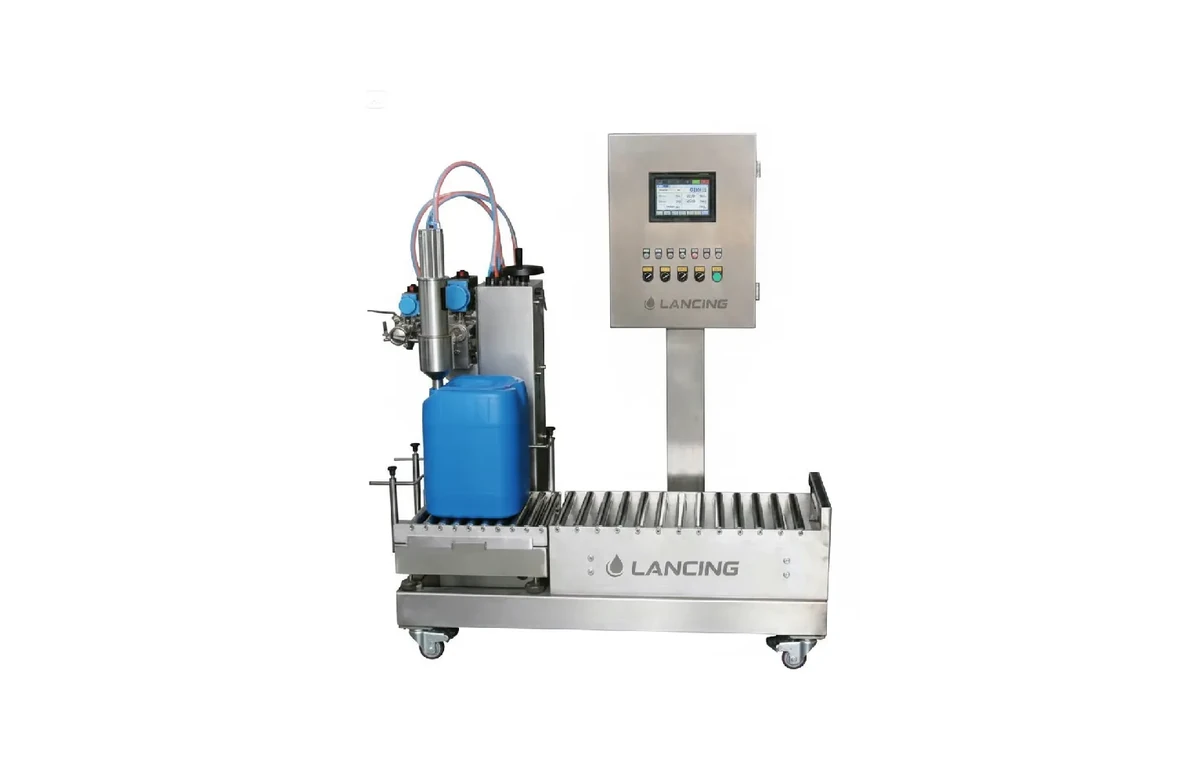
Contain the whole operating sequence
Include the supply connection, pump, hose, valves, nozzle, container opening, capping and movement of a damaged or leaking finished pack.
Containment layers
Give every credible release a defined collection and recovery route.
| Area | Release to consider | Evidence to define |
|---|---|---|
| Bulk source and transfer connection | Overfill, hose or coupling failure, valve leakage and disconnection residue | Isolation point, transfer supervision, local collection, hose drainage and site bund boundary |
| Filler tank, pump and manifold | Seal, diaphragm, fitting, hose, level-control or vessel leakage | Maximum credible inventory, tray/skid capacity, leak detection, access and emptying method |
| Nozzle and container | Cut-off drips, splash, foam overflow, mis-positioned or damaged pack | Drip collection, no-container interlock, overfill response, nozzle parking and contaminated-pack handling |
| Capping and downstream handling | Filled pack without closure, leaking closure, toppled container or damaged pallet | Isolation area, reject route, floor compatibility, recovery equipment and safe movement |
| Floor, bund and drainage | Release beyond the machine-mounted collection system | Impermeability, chemical resistance, gradients, drain isolation, collection point, alarms and restoration |
| Cleaning, flushing and waste | Rinse, neutralisation fluid, retained product and contaminated absorbent | Segregation, identification, permitted route, temporary storage and disposal responsibility |
Material and construction
Compatibility applies to bunds, floors, joints and seals as well as the filler.
Review the exact formulation, concentration, temperature, exposure time and any cleaning or neutralising fluid. Concrete, coatings, thermoplastics, metals, joint sealants and flexible liners can respond differently to the same product. Confirm the actual grade and construction rather than approving a generic material family.
Account for mechanical damage from pallets, forklifts, container edges and maintenance tools. A chemically resistant surface can still fail if joints open, a coating is punctured or a drain penetration bypasses the containment boundary.
Inspection and restoration checklist
- Visual condition of floors, trays, bunds, joints and penetrations
- Leak-detection and high-level devices where fitted
- Isolation valves, blind collection points and controlled emptying method
- Rainwater or cleaning-fluid removal without uncontrolled discharge
- Availability and compatibility of spill-response equipment
- Written release, cleaning and return-to-service record
UK environmental guidance
Use the current site and jurisdiction requirements, not a universal bunding rule copied from another application.
GOV.UK guidance for pollution prevention for businesses explains secondary containment for materials that could pollute the environment. The Environment Agency’s solvent groundwater-protection guidance also covers spills, pipework, drains and bunds. These sources support the site assessment but do not replace substance-specific, permit, fire-safety or DSEAR requirements.
Acceptance evidence
Test containment functions without creating an uncontrolled chemical release.
- Verify the boundary.Mark the supplied machine tray, skid, floor, bund, drain and site interfaces on the approved layout.
- Use a safe test method.Where appropriate, use dry checks or an agreed safe test liquid to prove level detection, isolation, collection and emptying.
- Challenge abnormal states.Confirm the response to overfill indication, container absence, pump stop, hose isolation and a leaking finished pack without simulating a hazardous uncontrolled release.
- Record restoration.Define who authorises cleaning, waste removal, inspection and return to production.
Buyer questions
Questions about chemical filling containment and bunding.
Is a machine drip tray the same as a bund?
No. A machine drip tray normally manages local routine drips or small releases. Secondary containment is defined around the credible release, the surrounding area, the stored or transferred quantity and the site risk assessment. The two layers may work together but should not be treated as interchangeable.
Can an SDS approve the material used for secondary containment?
An SDS is an important input, but it does not normally approve a specific lining, joint, seal or construction for every concentration, temperature and exposure time. Confirm chemical resistance with the containment-system or material supplier and consider cleaning fluids and mixtures.
Should a chemical filling area drain directly to the site drainage system?
Do not assume that an uncontrolled drain is acceptable. The site assessment should define how spills, contaminated wash water and rainwater are isolated, checked, collected and disposed of. The correct arrangement depends on the substance, location, environmental permit and drainage design.
Does ATEX equipment remove the need for secondary containment?
No. Explosion protection, vapour control and liquid containment address different hazards and environmental consequences. A project may require all three, depending on the product and site assessment.
Who should specify the containment boundary around the filler?
The responsibility should be recorded across the machine supplier, process integrator, building or drainage designer and site dutyholder. The machine order should state what is supplied on the skid and what remains a site interface.
Speak to Lancing
Define the supplied tray, the site containment and the recovery route together.
Send the product and SDS where relevant, source inventory, pack sizes, layout, drains, proposed containment boundary and credible release cases.