Controls and traceability
What should a chemical filling line alarm, interlock and record?
A chemical filling line should alarm or inhibit conditions that could create an unsafe action, an incorrect or untraceable pack, damage equipment or defeat an approved process. Records should capture the product or recipe, significant changes, alarms, counts and reject evidence needed for quality and troubleshooting—without collecting uncontrolled data that nobody reviews.
- Answer-first chemical filling guidance
- Project variables and evidence made explicit
- Final suitability depends on product and site review
Direct answer
Define the required response, not only the alarm name.
For each condition, state how it is detected, whether filling is inhibited, paused or stopped, what happens to containers already in the line, who may acknowledge or bypass the condition and what evidence remains. An alarm that leaves an unidentified part-filled pack in normal flow is not a complete control.
Use cause-and-effect and state-sequence descriptions for product supply, nozzle position, guards, container tracking, capping, labelling, rejection, downstream block and emergency recovery.
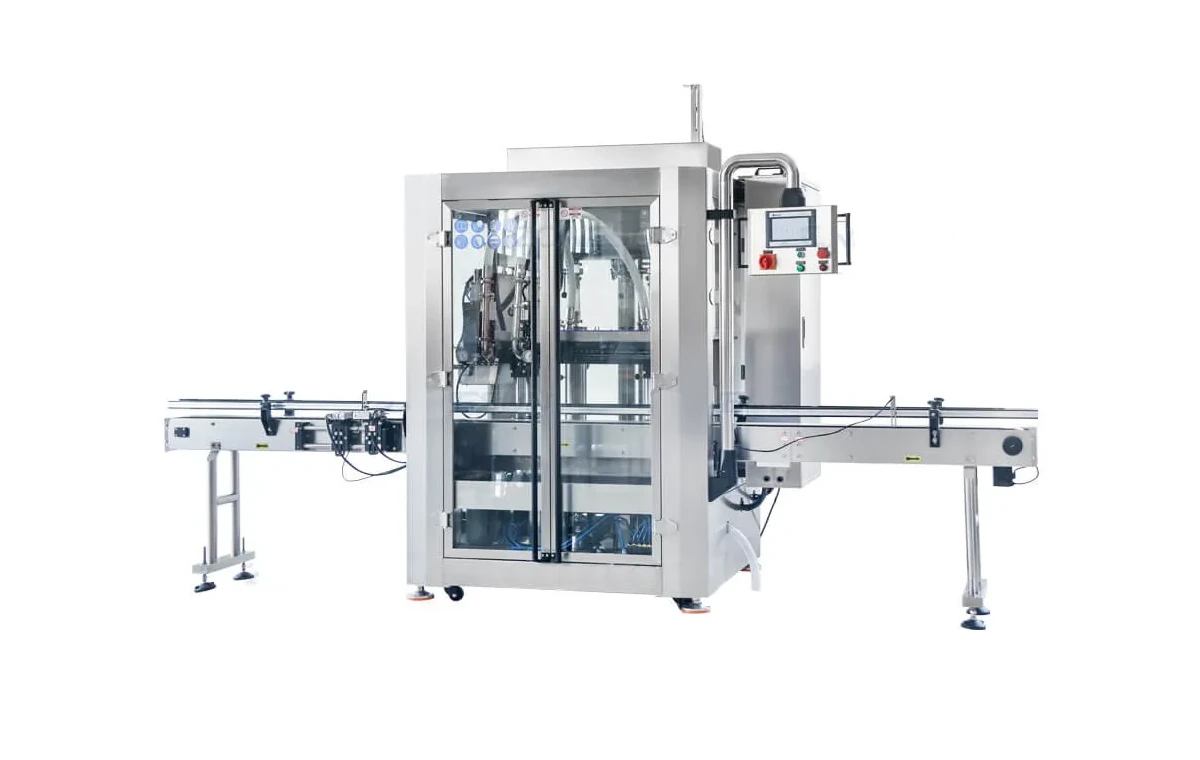
Use representative evidence
Approve the machine or process against the actual product, pack, operating range and site interfaces. Record assumptions and what must be confirmed by trial.
Decision table
Controls to define around the accepted chemical pack.
| Condition | Possible control response | Evidence to test |
|---|---|---|
| No or wrong container | Inhibit the affected fill or hold the line | Sensor challenge, pack spacing and recovery |
| Low product or unstable supply | Pause or stop before air or incomplete dose | Low-level trigger, part-filled pack treatment and reprime |
| Nozzle not in safe position | Prevent conveyor or fill movement | Position challenge and fault recovery |
| Guard or safety circuit open | Stop hazardous motion according to the assessed design | Functional test and controlled restart |
| Closure or label fault | Track, reject or hold the affected pack | Fault creation, reject confirmation and reconciliation |
| Bypass active | Restrict authority, display state and record use where required | Permission, indication, timeout or reset rule |
| Record unavailable | Defined line response or controlled manual process | Loss of network, storage or clock and later reconciliation |
Decision sequence
Build a useful control and record specification.
Define the pack states
Empty, filling, filled-open, capped, labelled, rejected, held and accepted.
Map faults to affected packs
State when tracking confidence begins and ends.
Assign permissions
Separate operator actions, maintenance overrides and engineering changes.
Choose records with an owner
Define who reviews each record, retention, export and backup.
Challenge recovery
Test stops, power loss, sensor fault, reject failure, low product and restart with packs in every critical position.
Avoidable errors
Common specification mistakes.
- Listing alarms without defining the line response.
- Allowing a bypass without clear indication, authority or reset.
- Counting a reject command as proof that a pack was removed.
- Recording every tag but not recipe changes or affected-pack reconciliation.
- Restarting after a stop without identifying part-filled or uncapped containers.
Buyer questions
Related questions about what should a chemical filling line alarm, interlock and record.
Which conditions should inhibit filling?
At minimum, inhibit when the required container, product supply, nozzle state, recipe, safety circuit or downstream condition is not confirmed for the approved process. The exact set depends on the risk assessment and line design; define the affected pack and recovery for each one.
How should bypasses be controlled?
Restrict bypass authority, show the active state clearly, record or time-limit use where justified, and define the compensating check. Safety functions must follow the assessed design and should not be casually bypassed to maintain output.
What should a reject system prove?
It should prove that the correct suspect pack was tracked to the reject point and physically removed or diverted. It should detect or respond to a failed reject, obstructed path, full bin or loss of tracking confidence.
Which batch records are useful for troubleshooting?
Useful records normally include product or recipe, approved settings, run times, accepted and rejected counts, significant alarms, authorised changes and quality checks. Keep only data with a defined purpose, owner, retention and reliable time reference.
Speak to Lancing
Send the process sequence and data requirement.
Include pack states, fault and reject philosophy, recipe permissions, batch-record needs, external systems and the required recovery for interrupted or suspect packs.