Upstream product supply
How should product supply be specified for a chemical filling machine?
Specify the product source, transfer route and operating limits as part of the filler—not as an undefined upstream service. Source height, available pressure, vessel level, pipe or hose size, temperature, return flow and empty-source behaviour can change priming, flow, foam, dose stability and pump suitability.
- Answer-first chemical filling guidance
- Project variables and evidence made explicit
- Final suitability depends on product and site review
Direct answer
Describe the minimum and maximum supply condition.
A filler that runs well from a full test hopper may behave differently when connected to a distant bulk tank at low level. The supply specification should state whether product is gravity-fed, drawn by the filler, pushed by a transfer pump or supplied through a controlled buffer vessel.
Include the vertical and horizontal route, line diameter, flexible hose, valves, filters, maximum and minimum pressure, allowable pulsation, product temperature and whether the source can introduce air, solids or temperature variation.
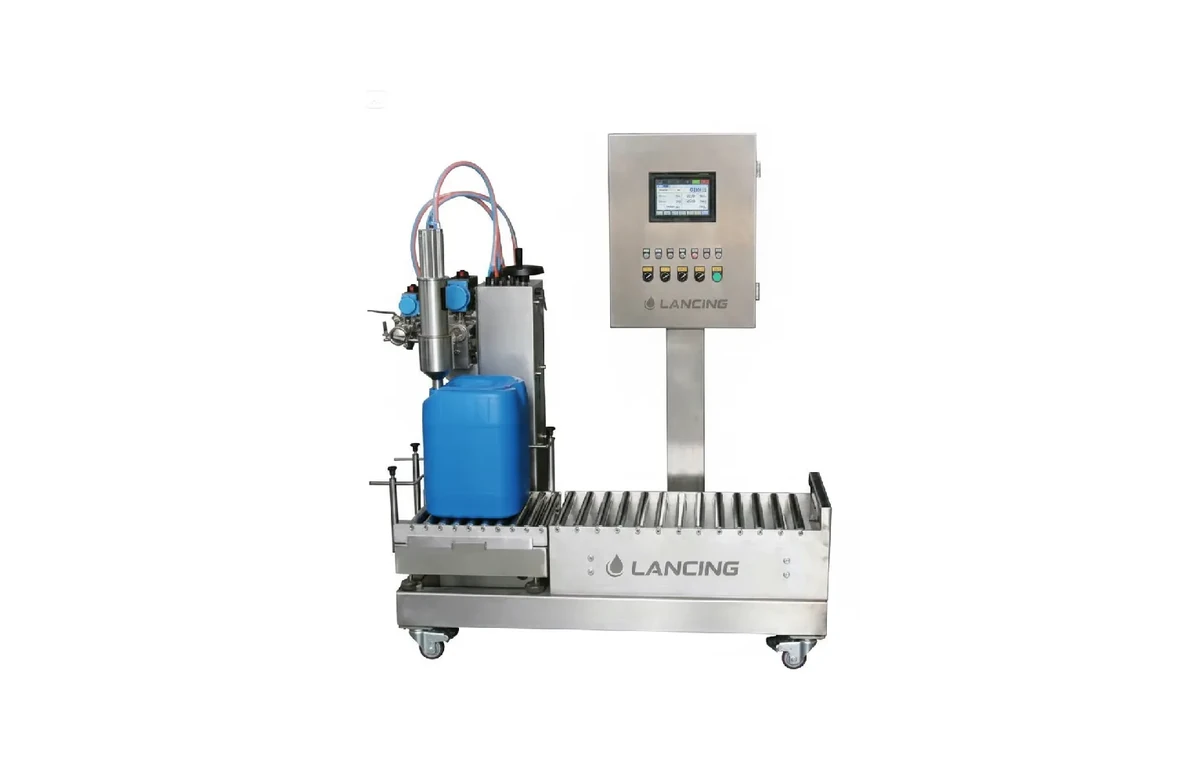
Use representative evidence
Approve the machine or process against the actual product, pack, operating range and site interfaces. Record assumptions and what must be confirmed by trial.
Decision table
Product-supply information that changes the filling decision.
| Input | Why it matters | What to provide |
|---|---|---|
| Source vessel and level | Changes static head, pickup and low-level behaviour | Vessel drawing, outlet position and minimum/maximum operating level |
| Distance and elevation | Affects suction loss, prime and required pump duty | Pipe or hose length, rise, fittings and internal diameter |
| Transfer pump or pressure | Can create pulsation, excess pressure or uncontrolled flow | Pump type, control method, pressure range and stop response |
| Filter or strainer | Adds pressure loss and can change as it loads | Mesh or element, clean/dirty condition and monitoring |
| Return or recirculation | Changes flow, air, heat, retained volume and cleaning | Return destination, entry position, control and low-level sequence |
| Product condition | Affects viscosity, density, foam and vapour | Temperature, batch age, mixing, settling and transfer method |
Decision sequence
Define product supply through every machine state.
Start and prime
State how an empty path is filled, air is removed and the first acceptable pack is identified.
Run at normal and extreme levels
Test source full and nearly empty, including realistic filter and hose conditions.
Detect low product
Define sensor, alarm, inhibit and treatment of any part-filled container.
Stop and isolate
State what happens on normal stop, emergency stop, power loss and upstream-pump overrun.
Drain, flush or change product
Include safe collection, retained volume, connection control and the clean endpoint.
Avoidable errors
Common specification mistakes.
- Using a small local hopper for FAT when the production machine will draw from a distant tank.
- Quoting pump flow without the actual suction and discharge conditions.
- Ignoring source-level change and filter loading.
- Allowing an upstream pump to keep pressurising a closed filler valve.
- Leaving product return, flushing and waste connections outside the line scope.
Buyer questions
Related questions about how should product supply be specified for a chemical filling machine.
Why does suction lift affect pump selection?
Suction lift and inlet restriction can reduce available pressure, make priming difficult and increase the risk of cavitation, air ingress or unstable flow. Provide the real elevation, line length, fittings, temperature and lowest vessel level so the pump is assessed at the difficult condition.
When is a buffer tank useful?
A buffer tank can decouple an unstable bulk supply from the filling cycle, provide a controlled head or support level control. It also adds retained volume, cleaning, overflow and containment duties, so it should be justified by the process rather than added automatically.
How should low-level and empty-tank conditions be handled?
Detect the condition early enough to prevent air or an incomplete dose, stop or inhibit filling in a controlled way, identify any part-filled pack and define how the product path is reprised without sending an unverified first pack forward.
What product-return or recirculation information is needed?
Define why the return exists, flow range, control valve or pump, destination, entry below or above liquid level, low-level behaviour, isolation, cleaning and whether the return can aerate, heat or separate the product.
Speak to Lancing
Send the upstream process with the filler enquiry.
Include a simple source-to-nozzle drawing, vessel levels, line sizes, transfer-pump details, pressure range, product condition, return route and the required low-product response.